
Smithfield is one of those Etobicoke neighbourhoods that does not always make the headlines, but the people who live there know exactly what it offers. The residential streets near John Garland Boulevard, Albion Road, and Kipling Avenue are home to hardworking families from across the Caribbean, West Africa, the Philippines, Eastern Europe, and beyond. It is a community shaped by immigration, resilience, and a strong sense of belonging.
It is also a neighbourhood where bed bugs are a real and growing concern, particularly in the townhouse complexes and low-rise residential buildings that line streets like John Garland Blvd near the M9V postal area. Our team at Bugs Heat Terminator recently completed a professional bed bug heat treatment for a family in this part of Etobicoke, and this post walks through what happened, how we handled it, and what other Smithfield residents should know.
A Family in Smithfield Reaches Out
The family had been dealing with unexplained bites for about two weeks before they contacted us. They had initially attributed the irritation to mosquitoes or an allergic reaction. When the bites kept appearing after every night of sleep, they began inspecting the bedroom more carefully.
What they found confirmed their concern: small dark stains along the mattress seam, a few pale shed skins tucked into the folds of the box spring, and eventually a live insect near the headboard. The signs were clear. They had a bed bug infestation.
What made the situation more pressing was the layout of their home. Townhouse properties in Smithfield, like many along John Garland Boulevard and the surrounding streets off Albion Road, share walls with adjacent units. A bed bug population that goes untreated in one home does not stay contained for long. The family acted quickly, and that decision made the treatment process significantly more straightforward.
What Smithfield’s Housing Stock Means for Bed Bug Risk
To understand why bed bugs spread the way they do in this part of Etobicoke, it helps to understand the neighbourhood itself.
The residential development of Smithfield took off in the post-war decades as part of the broader expansion of the Rexdale and Etobicoke district. Many of the townhouses and low-rise apartment buildings in the area near John Garland Blvd, Mount Olive Drive, and Silverstone Drive were constructed in the 1960s and 1970s. These properties share structural features that, decades later, create conditions where bed bugs can move and hide with relative ease.
Shared walls between townhouse units allow bed bugs to migrate through gaps in baseboards and around pipe penetrations. Common laundry facilities, frequently used by residents across multiple units, are another well-documented transfer point. High tenant turnover, which is common in neighbourhoods with a high proportion of rental housing like Smithfield, means that move-ins and move-outs happen regularly, each one a potential introduction event for bed bugs traveling in luggage, furniture, or boxes.
The proximity to Humber College’s North Campus on Humber College Boulevard also brings a transient student population to the surrounding streets, adding another layer of movement to an already active residential area. Students moving between rental properties seasonally are among the most common unknowing carriers of bed bugs in urban Toronto.
None of this means that bed bugs are inevitable in Smithfield. It means that residents here need to be informed and ready to act when the signs appear.
The Signs the Family Noticed and What They Mean
The warning signs this family identified are worth reviewing, because they are the same signs that many residents miss or misinterpret in the early stages of an infestation.
Bites appearing after sleep. Small, red, itchy marks on exposed skin such as the arms, neck, and shoulders after waking up are one of the most consistent early indicators. They are often dismissed as mosquito bites, but bed bug bites tend to appear in clusters or lines and show up repeatedly in the same pattern.
Dark staining on the mattress. The small rust-colored or brown spots found near mattress seams are fecal deposits left by feeding bed bugs. Finding these marks on bedding or along the edges of the mattress is a reliable physical sign of an active infestation.
Shed skins inside the box spring. Bed bugs molt as they grow through their life stages. Their translucent shed skins, often found in the folds of box springs, inside bed frames, or along the grooves of wooden furniture, are one of the clearest signs that the infestation has been developing for some time.
A live insect near the headboard. Seeing a live bed bug is confirmation. They are flat, oval, brownish, and roughly the size of an apple seed. They move quickly when disturbed and retreat to dark, tight spaces immediately.
If you have noticed any combination of these signs in your Smithfield or Etobicoke home, the right response is to stop waiting and contact a professional. Early treatment is always faster, simpler, and more contained than treatment of a fully established infestation.
How We Treated the Home
When our technicians arrived at the property near John Garland Blvd, the process began with a full inspection of the affected areas. We assessed the layout of the unit, identified the primary infestation zones, and evaluated how heat would move through the space given the shared wall construction typical of townhouses in this part of Etobicoke.
The family had followed our bed bug preparation checklist in advance. Heat-sensitive items had been removed, and the unit was ready for equipment setup when we arrived.
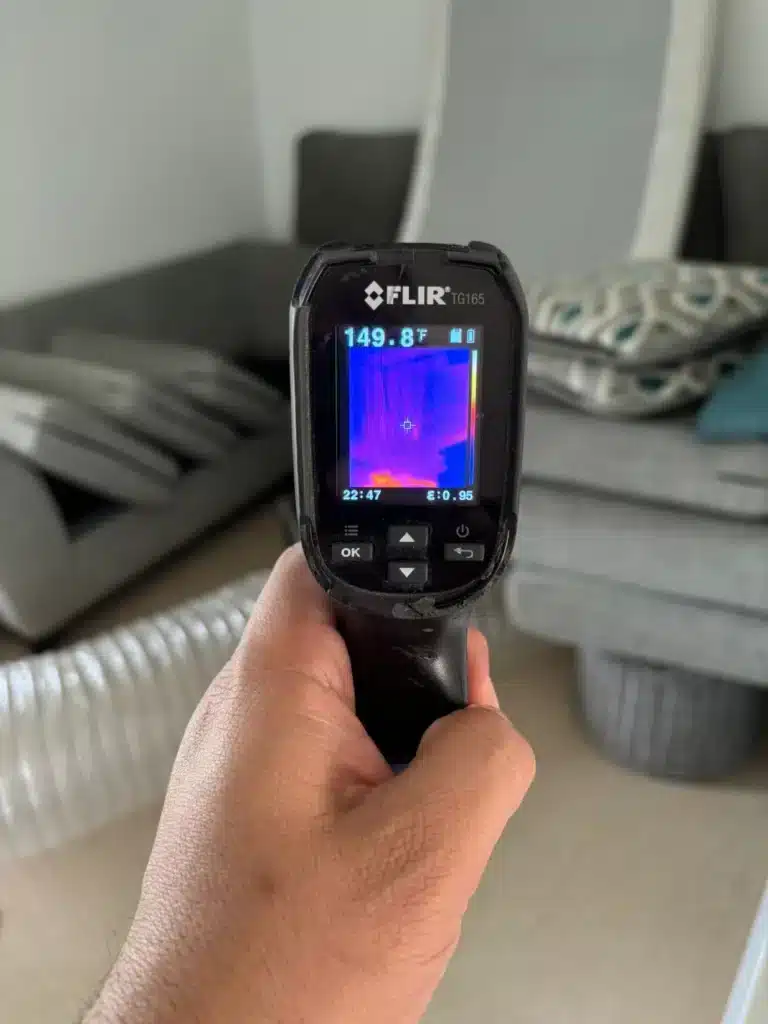
We positioned industrial electric heaters and high-volume circulation fans throughout the unit. Temperature sensors were placed in the hardest-to-heat areas, inside furniture, along exterior walls, near floor-level baseboards, and within closets, to monitor conditions in real time throughout the session.
The target temperature for our treatments is between 49°C and 57°C (120°F to 135°F), sustained long enough to reach every surface and void in the space. At these temperatures, bed bugs at every stage of their life cycle, from newly laid eggs to fully developed adults, cannot survive. There is no resistance mechanism that can protect them from sustained heat.
Our technician remained on site throughout the full session, tracking sensor readings and adjusting airflow to ensure even heat distribution across the entire unit. Once every zone confirmed lethal temperatures had been held for the required duration, we conducted a final walkthrough and cleared the home for reoccupancy.
The family returned to their home the same day. No chemical residue. No odor. No follow-up visits required.
Why Heat Treatment Works Better Than Chemicals in Townhouses
This is worth addressing directly, because many residents in Smithfield and across Etobicoke first attempt chemical sprays before calling a professional.
Chemical treatments kill bed bugs on contact but cannot penetrate inside mattresses, within wall voids, or beneath flooring. In a townhouse with shared walls, that incomplete penetration leaves population pockets untouched. Eggs, which are naturally resistant to most pesticide compounds, hatch weeks later and restart the infestation.
Heat treatment eliminates this problem entirely. The heat reaches everywhere the bugs hide, including the spaces no spray can touch, and it kills at the biological level with no resistance possible. For shared-wall properties like those on John Garland Blvd and Mount Olive Drive, that thoroughness is not optional. It is what makes the difference between a resolved infestation and a recurring one.
Serving Smithfield, Etobicoke, and the Surrounding Area
Bugs Heat Terminator provides professional bed bug extermination for families, landlords, and property managers throughout Etobicoke, including the Smithfield neighbourhood and properties along John Garland Boulevard, Albion Road, Kipling Avenue, Silverstone Drive, Mount Olive Drive, and the broader M9V postal area.
If you are a resident of Smithfield dealing with bed bugs, or if you have noticed the early warning signs described in this post, do not wait for the problem to grow. Contact Bugs Heat Terminator today for a professional inspection and fast, same-week service. We know this neighbourhood, we have worked in these homes, and we know how to get the job done right the first time.
