
Liberty Village is one of Toronto’s most sought-after neighbourhoods for a reason. Bordered by King Street West to the north, Dufferin Street to the west, Strachan Avenue to the east, and the Gardiner Expressway to the south, the area combines the character of converted industrial lofts with modern condo towers, walkable streets, and a strong community identity. It attracts young professionals, creatives, and entrepreneurs who want downtown Toronto living with a neighbourhood feel.
But the same features that make Liberty Village appealing also create specific conditions that make bed bugs harder to avoid and harder to eliminate. When a resident in the area contacted Bugs Heat Terminator after discovering signs of a bed bug infestation in their unit, we responded quickly and completed a full professional heat treatment that resolved the problem in a single visit. This post walks through what happened, why Liberty Village condos and lofts carry a higher bed bug risk than many residents realize, and what to do if you find yourself in the same situation.
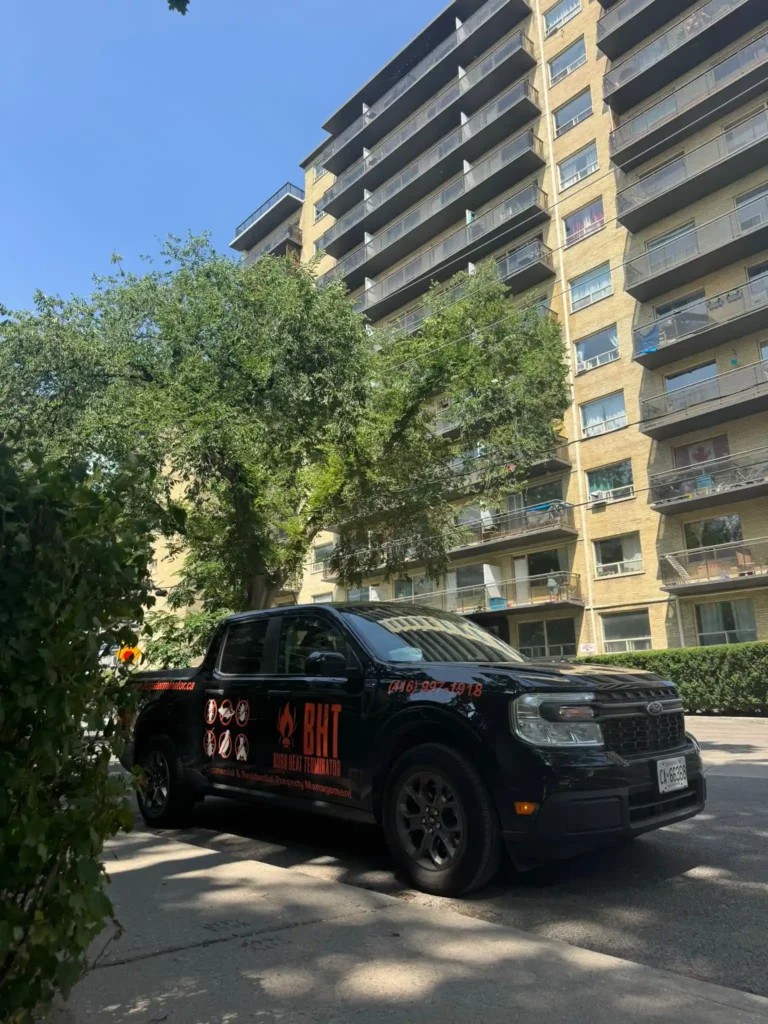
Why Liberty Village Condos Are Particularly Vulnerable
Liberty Village’s housing stock is unlike most other Toronto neighbourhoods. The area is defined by two distinct building types: hard lofts converted from former industrial buildings along streets like Hanna Avenue, Atlantic Avenue, and East Liberty Street, and modern glass and concrete condo towers that have risen rapidly since the mid-2000s.
Both building types share characteristics that increase bed bug risk in ways that single-family homes do not.
High Density and Constant Resident Turnover
Liberty Village has a population of roughly 7,500 residents within a compact 0.45 km² area, making it one of the densest residential communities in Toronto’s west end. With median rents above the Toronto average and a predominantly young professional demographic, the neighbourhood experiences significant tenant turnover each year. Every move-in is a potential introduction point for bed bugs traveling in luggage, furniture, or boxes from a previous residence.
Shared Infrastructure in Converted Loft Buildings
The hard loft buildings along Hanna Avenue and the surrounding streets were originally factories and warehouses. Buildings like the Toy Factory Lofts on Hanna Avenue, once the headquarters of Irwin Toys, have been converted into residential spaces that retain much of their original industrial construction. That construction, while architecturally distinctive, includes shared pipe chases, original brick cavities, and structural gaps that provide bed bugs with pathways between units that modern builds do not have.
Active Construction and New Developments
Liberty Village has been under near-continuous construction for over a decade. New condo projects along East Liberty Street and Western Battery Road bring waves of construction workers, subcontractors, and new residents into the neighbourhood regularly. This level of ongoing activity and movement is a consistent factor in bed bug spread across urban neighbourhoods.
What the Resident Noticed
The Liberty Village resident who contacted us had been experiencing unexplained bites for just under two weeks before reaching out. Like many people in the early stages of an infestation, they had attributed the irritation to other causes initially, checking for mosquitoes and reviewing whether anything in their diet or laundry products had changed.
When the bites continued appearing consistently after sleep, they inspected their mattress more carefully and found the physical evidence that confirmed the problem:
- Small dark staining along the mattress seam near the head of the bed
- Pale shed skins inside the folds of the box spring
- A faint, sweet musty odor in the bedroom that had developed gradually over the previous week
- A live insect spotted on the bed frame during a nighttime inspection
Acting quickly after identifying these signs of a bed bug infestation was the right call. In a dense building with shared walls, the longer an infestation goes untreated, the greater the risk of spread to neighboring units through wall voids, electrical conduit, and plumbing runs.
How We Treated the Unit
When our technicians arrived at the Liberty Village property, the first step was a thorough inspection of the affected areas. We assessed the unit layout, identified the primary infestation zones concentrated around the bedroom, and evaluated how heat would move through the space given the loft-style construction with high ceilings and exposed brick walls common to converted industrial buildings in this part of Toronto.
The Treatment Process
The resident had completed our preparation checklist in advance, removing heat-sensitive items and clearing the treatment zones. Our technicians then set up industrial electric heaters and high-volume circulation fans positioned strategically throughout the unit to ensure even heat distribution.
Temperature sensors were placed in the most heat-resistant areas:
- Inside the mattress and box spring
- Along the baseboard perimeter of the bedroom
- Near exterior-facing brick walls, which absorb and release heat differently than drywall
- Inside closets and storage areas adjacent to the sleeping zone
The unit was brought to a sustained temperature of between 49°C and 57°C (120°F to 135°F) throughout the entire space. Our technician monitored sensor readings continuously throughout the session, making airflow adjustments as needed to confirm that every zone reached and held lethal temperatures for the required duration.
Once the treatment cycle was complete, a final walkthrough confirmed full coverage across the unit. The resident returned to their home the same day, with no chemical residue, no re-entry waiting period, and no follow-up visits required.
What Makes Heat Treatment the Right Choice for Liberty Village Units
For residents of condos and lofts in Liberty Village, heat treatment addresses the specific challenges of this type of housing in ways that chemical approaches cannot.
Full penetration of industrial construction. The exposed brick, high ceilings, and original structural elements of converted loft buildings create more complex heat distribution challenges than standard drywall construction. Our equipment and sensor monitoring protocol is designed to address exactly this kind of variability, confirming lethal temperatures in every part of the space regardless of building material.
Single visit, same-day return. For working professionals in Liberty Village, the idea of multiple treatment sessions spaced weeks apart, each requiring full preparation and vacating the unit, is a significant disruption. Heat treatment resolves the infestation completely in one session.
No chemical residue. In a neighbourhood where residents frequently use shared amenities, entertain at home, and live in close proximity to neighbours, leaving no trace of treatment in the living environment matters.
Discreet. Treatment is conducted entirely inside the unit with no exterior equipment or visible indication to neighbors or building management beyond what the resident chooses to share.
Bugs Heat Terminator provides bed bug extermination services for condo residents, loft tenants, landlords, and property managers throughout Liberty Village and Toronto’s west end, including properties along King Street West, East Liberty Street, Hanna Avenue, Atlantic Avenue, Western Battery Road, and Dufferin Street.
If you are a Liberty Village resident who has noticed unexplained bites, dark staining on your bedding, or any of the other signs described in this post, do not wait to act. Bed bug populations grow steadily and spread predictably in dense residential buildings. The earlier treatment begins, the simpler and more contained the process will be.
Contact Bugs Heat Terminator today for a professional inspection and fast, same-week service in Liberty Village and across Toronto.
